



4 levels of hearing loss: understanding your hearing health

4 levels of hearing loss: understanding your hearing health
8 minutes
Published 5 June 2024
20 January 2025
Hearing loss can vary widely from person to person in terms of cause and severity. While ageing is a common cause, other factors like medical conditions and prolonged exposure to loud noise can also lead to hearing loss. Understanding the different hearing loss levels can help you better manage the condition and seek appropriate treatment.
What causes hearing loss?
Hearing loss can stem from various factors, leading to difficulties in social interactions and daily activities. Common causes include:
Ageing: natural decline in hearing ability over time.
Prolonged exposure to loud noises: regular exposure to high decibel levels can damage hearing.
Medical conditions: diseases such as meningitis can affect hearing.
Hereditary factors: genetic predisposition to hearing loss.
Certain medications: some medications have ototoxic side effects that impair hearing.
Hearing loss decibels chart
Hearing loss is measured in decibels (dB) and categorised into four levels: mild, moderate, severe, and profound. Normal hearing allows detection of sounds between 20-25 dB across all frequencies.
Level of hearing loss | Decibel | Symptoms | Sounds that you are missing | Recommendation |
|---|---|---|---|---|
Mild hearing loss | Trouble hearing sounds under 40 dB | Difficulty hearing soft-spoken words, the hum of a refrigerator, or a ticking clock. | Birds chirping, rustling leaves, distant whispers. | A hearing test by a specialist can confirm mild hearing loss and recommend appropriate solutions. |
Moderate hearing loss | Difficulty hearing sounds below 41 to 55 dB | Harder to distinguish consonant and vowel sounds. Sounds are heard but not clearly understood. | Normal conversation, laughter, the sound of a boiling kettle. | Seeking professional help is crucial for managing moderate hearing loss. |
Moderate-to-severe hearing loss | Inability to hear sounds below 56-70 dB without hearing aids | Even with hearing aids, understanding speech might be challenging. | Doorbells, ringing phones, a ticking alarm clock. | Use of additional communication strategies like lip reading. |
Severe hearing loss | Inability to hear sounds below 70 to 90 dB | Inaudibility of everyday noises like a ringing phone. | Traffic noise, a crying baby, a dog barking. | Hearing aids or cochlear implants are essential for improving quality of life. |
Profound hearing loss | Only hearing sounds above 90 dB | Even loud noises, such as an aeroplane engine, may be inaudible. Reliance on lip reading for communication. | Fire alarms, police sirens, loud music at a concert. | Professional evaluation and use of hearing aids for partial improvement. |
You can read more about the noise levels of everyday sounds in our guide.
Recognising the signs of hearing loss
Hearing loss often develops gradually, making it hard to notice at first. Look out for these signs:
• TV volume: others complain that the TV is too loud.
• Background noise: difficulty following conversations in noisy environments.
• Phone conversations: challenges hearing clearly over the phone.
• Repeating questions: frequently asking people to repeat themselves.
• Mumbling speech: feeling that others are mumbling.
If you or someone you know shows signs of hearing impairment, it’s essential to consult a hearing specialist for a thorough assessment and treatment recommendations.
The importance of regular hearing tests
One in twelve people in the UK experiences hearing loss. For those over 50, regular hearing tests every two years are recommended to monitor hearing health and detect changes early.
Book a free hearing test
At Boots Hearingcare, we offer free hearing tests conducted by qualified audiologists. Our tests are designed to be quick, they only take 15 minutes and provide immediate feedback.
Here’s what you can expect:
Ear health check
Examination of your ears to ensure there are no physical issues affecting your hearing.
Hearing tests
Simple tests to measure your hearing capabilities.
Expert advice
Personalised recommendations to improve your hearing.
If signs of hearing loss are detected, we will schedule a more comprehensive 75-minute assessment.
Try our online hearing test
If you want to test your hearing before visiting us in-store, you can try our quick and easy online hearing test. This preliminary test can give you an idea of your hearing health and help you decide if you need a professional assessment. Try our online hearing test now.

Bringing a companion
You’re welcome to bring a friend, partner, or family member to your hearing test. Having someone with you can help remember the advice given and provide additional insights into your hearing difficulties.
Helping a loved one with hearing loss
If you suspect a loved one has hearing loss, it can be challenging for them to notice the gradual changes. Here’s how you can help:
• Choose quiet places: engage in conversations in quieter settings.
• Face visibility: ensure they can see your face when you’re talking.
• Encourage testing: motivate them to book a free hearing test and offer to accompany them.
• Be patient: if they need a hearing aid, support them as they adjust.
Understanding and reading an audiogram
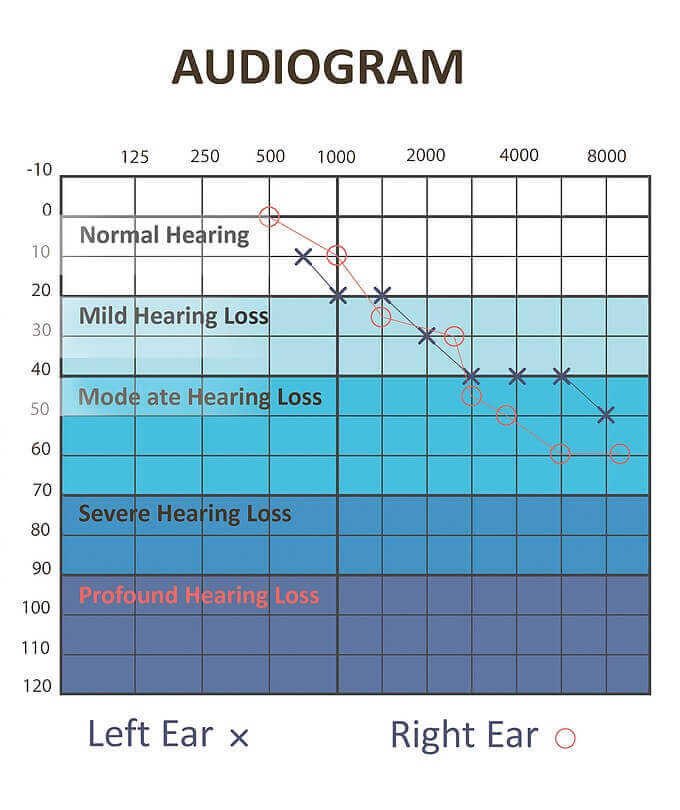
An audiogram is a graph or chart that displays the results of your comprehensive hearing evaluation.
X-axis: shows different pitches of sounds played during your test (low-pitched sounds on the left, higher pitches on the right).
Y-axis: shows the loudness, increasing as you go down the graph.
Circles (red): represent your right ear.
Crosses (blue): represent your left ear.
Frequently asked questions
Author
Boots Hearingcare
Boots Hearingcare